- English
- 简体中文
- Esperanto
- Afrikaans
- Català
- שפה עברית
- Cymraeg
- Galego
- 繁体中文
- Latviešu
- icelandic
- ייִדיש
- беларускі
- Hrvatski
- Kreyòl ayisyen
- Shqiptar
- Malti
- lugha ya Kiswahili
- አማርኛ
- Bosanski
- Frysk
- ភាសាខ្មែរ
- ქართული
- ગુજરાતી
- Hausa
- Кыргыз тили
- ಕನ್ನಡ
- Corsa
- Kurdî
- മലയാളം
- Maori
- Монгол хэл
- Hmong
- IsiXhosa
- Zulu
- Punjabi
- پښتو
- Chichewa
- Samoa
- Sesotho
- සිංහල
- Gàidhlig
- Cebuano
- Somali
- Тоҷикӣ
- O'zbek
- Hawaiian
- سنڌي
- Shinra
- Հայերեն
- Igbo
- Sundanese
- Lëtzebuergesch
- Malagasy
- Yoruba
- Español
- Português
- русский
- Français
- 日本語
- Deutsch
- tiếng Việt
- Italiano
- Nederlands
- ภาษาไทย
- Polski
- 한국어
- Svenska
- magyar
- Malay
- বাংলা ভাষার
- Dansk
- Suomi
- हिन्दी
- Pilipino
- Türkçe
- Gaeilge
- العربية
- Indonesia
- Norsk
- تمل
- český
- ελληνικά
- український
- Javanese
- فارسی
- தமிழ்
- తెలుగు
- नेपाली
- Burmese
- български
- ລາວ
- Latine
- Қазақша
- Euskal
- Azərbaycan
- Slovenský jazyk
- Македонски
- Lietuvos
- Eesti Keel
- Română
- Slovenski
- मराठी
- Srpski језик

Why Are Slotted Machine Screws Essential for Industrial Assembly Projects?
Abstract
This article systematically analyzes the definition, structural characteristics, material selection, processing technology, application scenarios, installation specifications, quality control and supplier selection of Slotted Machine Screws. It focuses on solving the pain points of unstable fastening, difficult installation and short service life in mechanical assembly. Combined with the production advantages of professional manufacturers, it provides a complete reference for engineers, purchasers and maintenance personnel to select, use and manage such fasteners, helping to improve assembly efficiency, reduce failure rate and extend equipment service cycle.
Table of Contents
- 1. Basic Overview and Core Value of Slotted Machine Screws
- 2. Main Types and Structural Characteristics
- 3. Material Selection and Surface Treatment Processes
- 4. Typical Application Fields and Installation Requirements
- 5. Quality Control Standards and Testing Items
- 6. How to Choose Reliable Suppliers
- 7. FAQ
- 8. Conclusion
1. Basic Overview and Core Value of Slotted Machine Screws
In modern industrial production, mechanical assembly and equipment maintenance are inseparable from reliable fasteners. Among many fastening products, Slotted Machine Screws have become one of the most widely used basic components in the manufacturing field due to their simple structure, convenient operation and stable fastening performance. They are mainly used to connect and fix two or more precision parts, ensuring the relative position stability of components during high-speed operation, vibration and load changes, and providing basic safety guarantee for the normal operation of the whole equipment.
Unlike self-tapping screws, wood screws and other products, slotted machine screws rely on precise threaded fit to achieve connection, usually used with nuts or pre-tapped holes, with high positioning accuracy and strong interchangeability. The single-slot driving design allows quick installation and removal with a standard slotted screwdriver, which is very suitable for assembly lines, maintenance sites and scenes requiring frequent disassembly. With the development of industrial automation and intelligent manufacturing, the demand for high-precision, high-strength and high-corrosion-resistance slotted machine screws is increasing year by year, and they are widely used in electronic equipment, mechanical equipment, automotive parts, instrumentation and household appliances.
The core value of such screws is reflected in three aspects: first, high reliability, uniform force, not easy to loose under vibration environment; second, strong versatility, compatible with standard tools, reducing the cost of tool configuration; third, easy maintenance, simple disassembly and assembly, shortening equipment maintenance time. For enterprises, choosing high-quality slotted machine screws can not only improve product assembly quality, but also reduce after-sales failures and save comprehensive operation costs.
2. Main Types and Structural Characteristics
Slotted machine screws are divided into multiple categories according to head shape, end structure and use scenarios, each with unique application advantages. Professional manufacturers provide targeted designs for different working conditions to meet diversified assembly needs.
2.1 Classification by Head Shape
- Slotted Cheese Head Screws: Cylindrical head, moderate height, large force area, suitable for scenes requiring high surface strength and frequent disassembly, such as mechanical boxes, motor end covers.
- Slotted Pan Head Machine Screws: Arc top, flat bottom, smooth transition, beautiful appearance, large contact area, not easy to damage the workpiece surface, widely used in electronic products, household appliances and furniture.
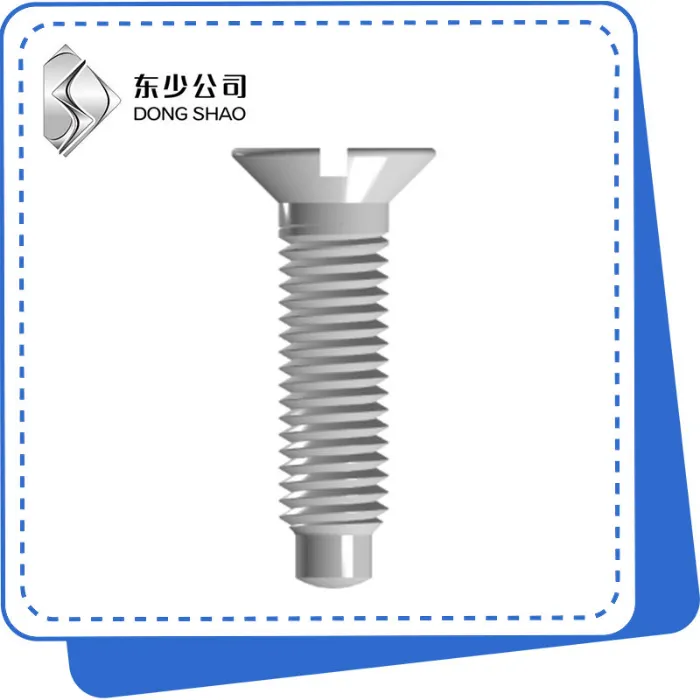
- Slotted Countersunk Head Screws: Conical head, can be embedded in the workpiece surface after installation, keep the surface flat and smooth, suitable for scenes with high appearance requirements, such as instrument panels, precision equipment shells.
- Slotted Raised Countersunk Head Screws: Arc top on the basis of countersunk head, combining the advantages of embedding and beauty, enhancing head strength, suitable for outdoor equipment and mechanical structures with certain impact resistance requirements.
2.2 Classification by End Structure
- Full Dog Point: Cylindrical end, with good positioning effect, suitable for precise positioning holes, reducing assembly deviation, common in precision instruments and transmission mechanisms.
- Flat End: Standard end, universal, suitable for most general assembly scenes, cost-effective.
Each type is designed to balance fastening force, installation convenience and appearance effect. Users should select the appropriate head shape and end structure according to the workpiece material, installation space, surface requirements and load conditions to maximize performance.
3. Material Selection and Surface Treatment Processes
The performance of slotted machine screws largely depends on material and surface treatment. High-quality raw materials and advanced processes ensure tensile strength, yield strength, hardness and corrosion resistance, adapting to complex working environments such as high temperature, humidity and corrosion.
3.1 Common Materials
| Material | Performance Characteristics | Application Scenarios |
|---|---|---|
| Carbon Steel | High strength, low cost, good processability, suitable for heat treatment | General machinery, automotive parts, daily hardware |
| Stainless Steel 304 | Excellent corrosion resistance, moderate strength, non-magnetic | Electronic equipment, food machinery, outdoor products |
| Stainless Steel 316 | Ultra-high corrosion resistance, suitable for harsh environments | Marine equipment, chemical machinery, coastal facilities |
| Brass | Good electrical conductivity, corrosion resistance, soft texture | Electrical appliances, communication equipment, decorative parts |
3.2 Surface Treatment Processes
- Galvanizing: Low cost, good corrosion resistance, widely used in carbon steel products, salt spray test up to 48-72 hours.
- Hot-dip Galvanizing: Thick coating, ultra-high corrosion resistance, suitable for outdoor and anti-corrosion demanding scenes.
- Electroless Nickel Plating: Uniform coating, high hardness, wear resistance and corrosion resistance, suitable for precision components.
- Passivation: Enhances the oxide film on the surface of stainless steel, improves corrosion stability, and maintains metallic luster.
Reasonable matching of materials and surface treatments can significantly extend the service life of screws. For example, 316 stainless steel with passivation treatment can be used for decades in marine environments without rust; carbon steel with galvanizing meets the needs of indoor general machinery, balancing performance and cost.
4. Typical Application Fields and Installation Requirements
The versatility and reliability make slotted machine screws cover almost all industrial manufacturing and daily consumer product fields. Understanding application scenarios and standard installation specifications helps to give full play to product performance and avoid failures caused by improper use.
4.1 Key Application Fields
Electronic and Electrical Industry: Used in the assembly of chassis, circuit boards, power sockets and other components, requiring small size, high precision and good conductivity, mostly pan head or countersunk head structures.
Mechanical Equipment Manufacturing: Applied to machine tools, motors, pumps, valves and other equipment, bearing large loads, requiring high strength and good anti-loosening performance, cheese head and countersunk head are common choices.
Automotive and Parts: Used in interior parts, engine accessories, chassis components, requiring vibration resistance, high temperature resistance and stable size, matching special materials and surface treatments.
Instrumentation: High-precision positioning and beautiful appearance are required, mostly using raised countersunk head or full dog point structures to ensure assembly accuracy and surface flatness.
Household Appliances and Furniture: Focusing on appearance and ease of installation, pan head products are widely used in TVs, refrigerators, washing machines and panel furniture, with low damage to the workpiece surface.
4.2 Standard Installation Requirements
- Ensure the matching of screw specifications and threaded holes, no forced assembly to avoid thread damage.
- Use a standard slotted screwdriver to avoid slipping and damaging the slot.
- Control tightening torque, not too loose or too tight, to prevent loosening or screw breakage.
- For vibration-prone scenes, use with spring washers or thread locking compounds to enhance anti-loosening effect.
- Keep the installation surface clean and free of impurities to ensure uniform stress.
Standardized installation can not only ensure fastening effect, but also extend the service life of screws and workpieces, reducing the failure rate of the whole machine.
5. Quality Control Standards and Testing Items
High-quality slotted machine screws must pass strict quality control to meet national and international standards. Professional manufacturers establish a complete quality management system from raw material incoming inspection to finished product delivery.
5.1 Common Quality Standards
- GB/T national standards: specifying dimensions, tolerances, mechanical properties and surface roughness.
- ISO international standards: ensuring global interchangeability and compatibility.
- ASTM standards: mainly for export products to the American market, with strict mechanical performance requirements.
- DIN standards: in line with European market specifications, focusing on precision and consistency.
5.2 Key Testing Items
- Size Detection: Use calipers, go-no-go gauges and projectors to check outer diameter, length, head size and thread accuracy to ensure compliance with drawings.
- Mechanical Performance Test: Tensile test, torque test, hardness test to verify tensile strength, yield strength and hardness meet standard values.
- Surface Treatment Test: Coating thickness test, adhesion test, salt spray test to evaluate corrosion resistance and coating stability.
- Appearance Inspection: No cracks, burrs, deformation, slot damage and other defects, ensuring smooth surface and uniform color.
Enterprises with complete testing capabilities can guarantee the stability of each batch of products, reduce the risk of customer use, and win long-term trust in the market.
6. How to Choose Reliable Suppliers
Choosing a reliable supplier is crucial to obtaining high-quality slotted machine screws. Purchasers should comprehensively evaluate from production capacity, technical level, quality control, delivery capacity and after-sales service.
6.1 Core Evaluation Dimensions
- Production Strength: Have professional production lines, mold processing capabilities and automated equipment to ensure large-scale and stable supply.
- Technical R&D: Ability to customize non-standard products, solve special scene needs and provide technical support.
- Quality System: Pass ISO9001 and other certifications, with complete testing equipment and strict quality control processes.
- Service Capacity: Provide fast quotation, on-time delivery, perfect after-sales support and timely response to problems.
- Cost Performance: Reasonable price under the premise of ensuring quality, reducing customer procurement costs.
Hebei Dongshao Fastener Manufacturing Co., Ltd. is a professional manufacturer focusing on the R&D and production of slotted machine screws. With advanced production technology, strict quality control and perfect service system, it provides customers with high-quality products of various head shapes and materials. The company's products are widely used in global machinery, electronics, automotive and other fields, winning high recognition from customers with stable quality and on-time delivery.
When selecting suppliers, priority should be given to manufacturers with independent factories, professional teams and rich industry experience, which can not only guarantee product quality, but also provide customized solutions to meet personalized needs.
7. FAQ
Q1: What is the difference between slotted machine screws and other types of screws?
A: Slotted machine screws adopt single-slot drive, matched with nuts or pre-tapped holes, with high precision and good interchangeability; self-tapping screws do not need nuts, suitable for soft materials; wood screws are used for wood materials with deep threads. They differ in structure, use and fastening principle.
Q2: How to choose the right head shape for slotted machine screws?
A: Choose according to installation needs: pan head for beautiful appearance and large contact area; countersunk head for flat surface; cheese head for high strength; raised countersunk head for combining embedding and strength.
Q3: What materials are suitable for outdoor use?
A: 304 or 316 stainless steel with passivation treatment, or carbon steel with hot-dip galvanizing, with excellent corrosion resistance, adapting to humidity, rain and salt spray environments.
Q4: How to prevent loosening in vibration environments?
A: Use with spring washers, flat washers or thread locking compounds; control appropriate tightening torque; choose high-strength materials to enhance anti-loosening performance.
Q5: Can non-standard sizes and materials be customized?
A: Professional manufacturers can customize non-standard specifications according to customer drawings, including special sizes, materials, surface treatments and end structures to meet personalized assembly needs.
8. Conclusion
As a basic and important fastener, Slotted Machine Screws play an irreplaceable role in industrial manufacturing, equipment assembly and daily maintenance. Their performance directly affects the quality, safety and service life of products. Understanding their types, materials, applications, installation and quality control helps users make scientific choices and use them correctly.
With the continuous progress of manufacturing industry, the demand for high-performance, high-precision slotted machine screws will continue to grow. Choosing professional and reliable suppliers is the key to ensuring product quality. Whether it is standard products or customized solutions, high-quality fasteners can provide a solid foundation for enterprise production and product upgrading.
In the future, with the development of intelligence and green manufacturing, slotted machine screws will move towards higher strength, longer life and more environmental protection. Enterprises focusing on quality and innovation will lead the industry development and provide better fastening solutions for global industrial progress.